
A sustainable use of proceeds bond signals to investors which sustainability theme (e.g., green, social, sustainability, blue, etc.) their capital will go towards. After issuance, an annual allocation and impact report, typically until full allocation, “should” tell investors how the issuer allocated its proceeds and what it delivered.
Sustainable bond investors rely on allocation and impact data for reporting, screening and benchmarking. Given the lack of standardisation, investors are increasingly relying on external data providers to make sense of unstructured data across issuers.
This article looks at where most reports fall short, why the gaps persist, the hardest cases of social and sovereign bonds, what is changing, and what good reporting looks like.
Where does the trail go cold?
Common weaknesses in post-issuance reports include:
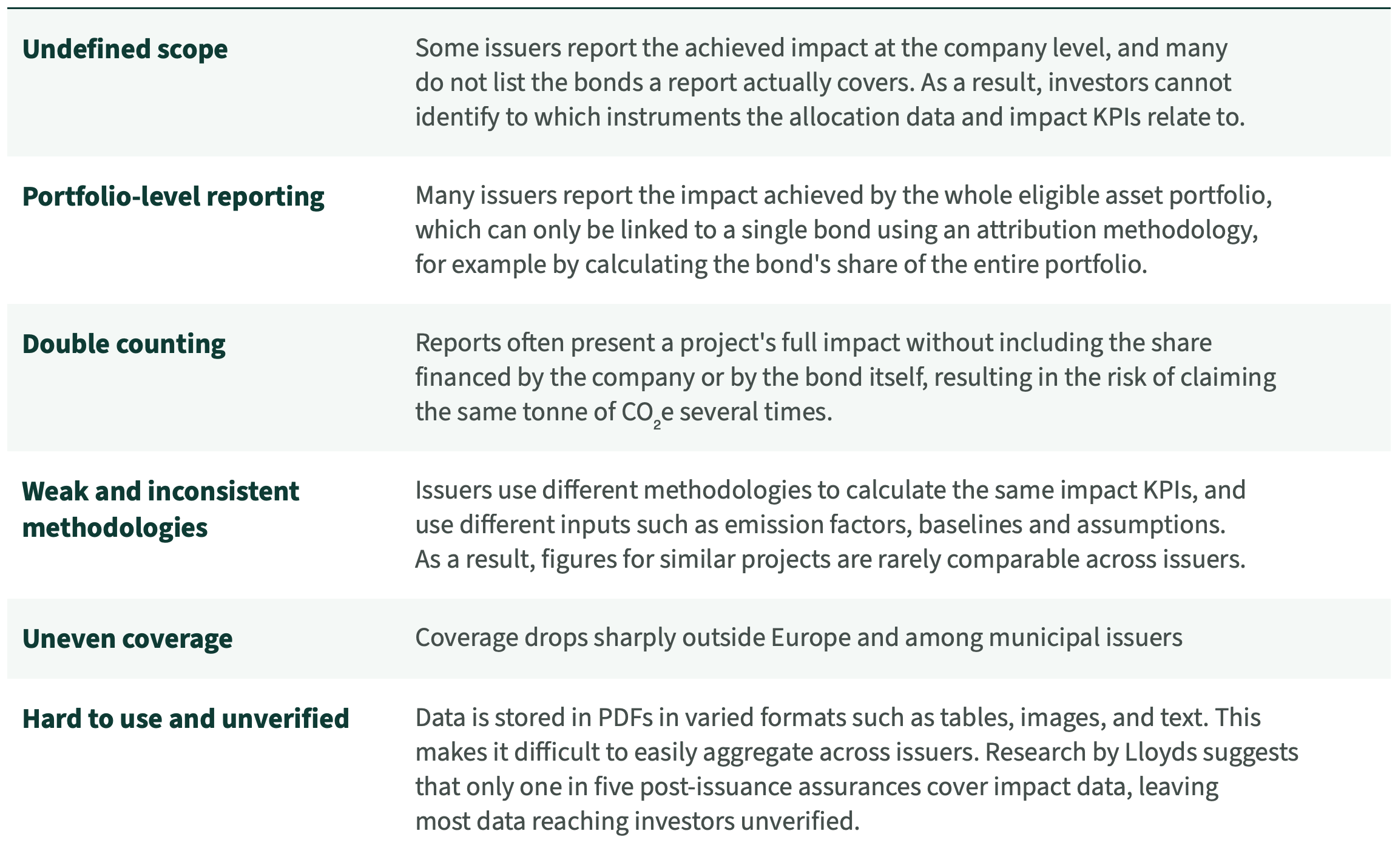
These gaps have practical consequences for investors. A fund that reports GHG emissions avoided per million invested cannot do so for a bond whose issuer reports only company-level KPIs and does not include bond references. It must either apply its own assumptions and calculate it manually or exclude the bond from their reporting to take a conservative approach. This is why investors increasingly turn to external data providers to fill this gap coupled with ad-hoc engagement.
Unable or unwilling? Why the gaps persist
The gaps are not always a matter of will. Banks issuing green bonds depend on their borrowers for project data, which often arrives at different times and in inconsistent formats. Many projects take years to become operational, so early reports can only offer estimates. For smaller and emerging-market issuers, the cost of data collection, methodology and external review is significant relative to the size of the bond.
Double counting: reports often present a project's full impact without including the share financed by the company or by the bond itself
Supervisors have also recognised these challenges. ESMA's thematic note on impact claims, published on 12 October 2026 gives examples of poor practice, including allocating proceeds to general pools so that impact cannot be attributed; reporting total benefits without including the bond's share; and swapping committed outcome metrics for simpler ones without explanation. ESMA also warns against citing positive second-party opinions when the promised reporting has not followed.
When counting isn't measuring: social bonds and sovereigns
Social bonds face a different problem: the underlying data exists, but reported KPIs often says very little. Most social indicators revolve around the number of beneficiaries from issuer investments. Knowing that 50,000 patients were treated shows what was financed, not whether anyone's health improved. The same count can also mean very different things in different places. Financing hospital capacity in the UK, where universal access to care already exists, is not comparable to financing new facilities in a region where little care is available. Issuers can do better by defining the target population, adding outcome indicators where data exists and setting baselines against which change can be measured.
Sovereigns are among the largest issuers of green, social and sustainable bonds. However, their reporting of outcomes faces structural limits. Proceeds are used to fund budget expenditure rather than discrete assets and often include subsidies or tax relief whose impact can only be estimated through policy evaluation. Emerging-market sovereigns face deeper gaps: a World Bank study of sovereign green, social and sustainability bonds found that a third of issuers reported late and only 30% of indicators matched the ICMA core indicators. Because sovereign green bonds are core holdings for many green bond funds, these limits flow straight into investors' own figures.
From goodwill to scrutiny: what is changing
Today, the two main frameworks set different floors:
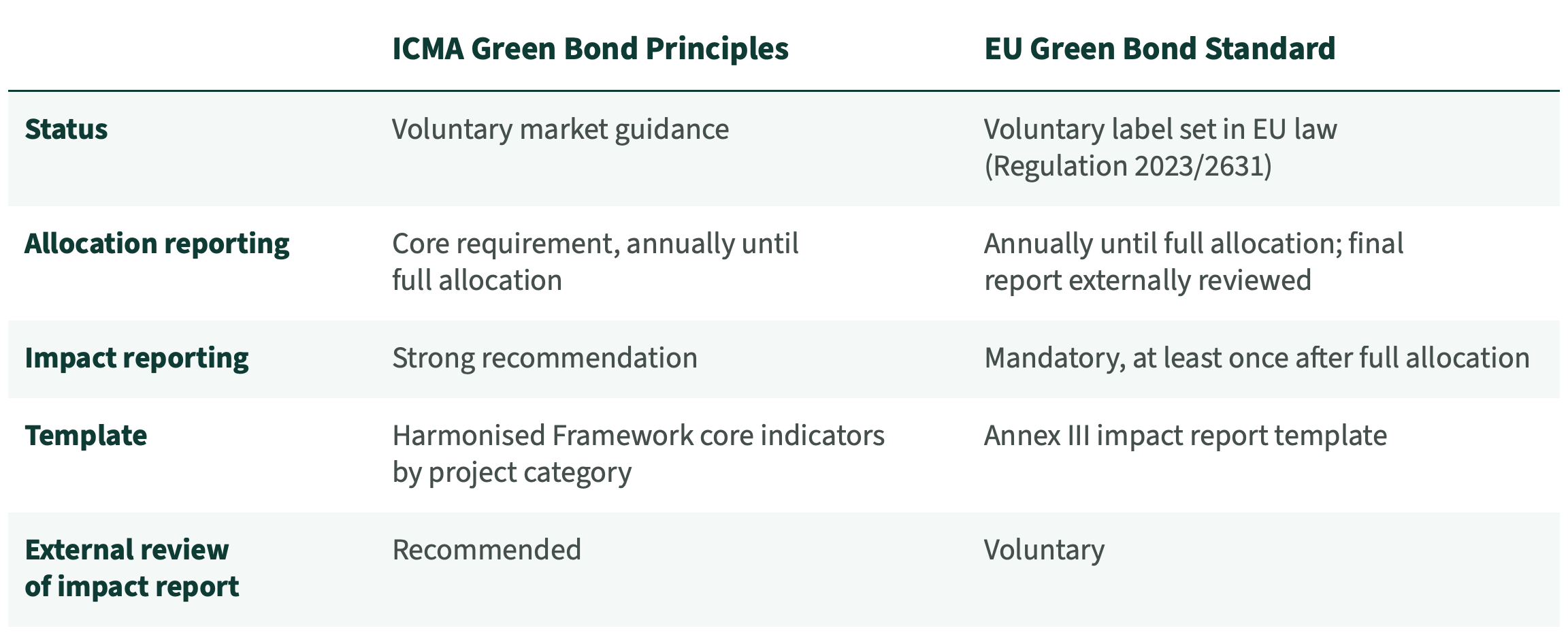
When looking at these main framework providers, the direction of travel is towards more structure and more scrutiny. Whilst impact reporting is a strong recommendation under ICMA’s bond principles, it is a legal requirement for bonds carrying the EU Green Bond Standard.
ESMA's thematic notes gives the market a reference for judging impact claims and demonstrates this is an area they are paying close attention to. Investors and data providers, meanwhile, are pushing for bond-level data that can be compared across issuers. Issuers that report well today will find these changes easier to absorb.
Can investors follow every euro? What good looks like
Investors are not asking for longer reports. They want reports they can trace and compare. The allocation section should how much of the bond proceeds has been spent, on which projects, how much was used to refinance existing assets and how much remains unallocated. The impact section should then report on the impact delivered by those projects, such as GHG emissions avoided in tCO2e, megawatts of renewable capacity installed, or number of affordable homes built.
The best reports make the link between the two explicit, with bond ISINs included so investors can see each bond's allocation and impact directly. They report allocation and impact for the same projects and state the bond's financed share of each, so that impact is not double counted.
Among credible impact reports include the Dutch State (its annual green bond report shows how eligible expenditures are allocated bond by bond); Lumo and Ørsted.
Building on this, issuers should report on impact using the ICMA core indicators so investors can make comparisons across issuers; publish their methodologies and underlying assumptions such as baselines and emission factors used; distinguish estimates from measured results; and move beyond outputs to outcomes, particularly for social projects.
Not every issuer can do all of this at once, and the steps should be proportionate to the size of the bond and the data available. Publishing the data in a usable format and being honest about gaps and delays will help build trust. The final step is independent verification or calculation of the impact figures and not just review of the allocation.
Conclusion
Allocation reporting shows where the money went. Impact reporting shows what difference it made, and the two need to be read as one. The issuers that let investors follow each euro or dollar from allocation to outcome will be the ones whose labels keep their value.